+44 20 7903 7116


 +44 20 7903 7116

With time, teeth change colour: ageing, diet (coffee, tea, red wine), smoking and some medicines gradually darken or yellow them, even with good care. Yellowing and stains are usually a cosmetic problem rather than a sign of decay, although the habits behind them can also harm teeth, so a dental check-up is always worthwhile. Many people lose confidence in their smile, which can affect their social and professional life. Teeth whitening is one solution, and Aram Clinic organises teeth whitening in Turkey with partner dental clinics. Whether it is the right choice depends on your teeth, the method and the price of the whole trip; this page explains the options, the risks and what to check before you decide.
Teeth whitening in Turkey is generally less expensive than in the UK or the US, but the saving depends on what you compare; Aram Clinic says it aims to offer a good service at a cost that suits many budgets. It offers, according to the clinic, an all-inclusive package for teeth whitening in Turkey. According to the clinic, the package covers your hotel room, your transportation, your doctor and your medication; ask for the exact list of inclusions and exclusions. Price is only one factor: the dentist, the product and the examination matter more.
What are the Teeth whitening methods ?
Teeth whitening lightens the colour of the teeth: a peroxide gel breaks down the pigments in and on the enamel, and the treatment can include cleaning the teeth of plaque and food deposits.The teeth whitening process has gone through many developmental stages, some of which are effective and some ineffective, and some of which have disappeared with time because of their side effects.
As for the methods that are used today in teeth whitening in Turkey, they are divided into two parts :
Teeth whitening at the doctor's office.
this includes several methods, the most important of which is whitening with a bleaching gel (hydrogen peroxide) applied to the teeth after the gums are protected, with or without a light. A faster, light-activated method that is very popular in dental centres is known as laser teeth whitening; the extra effect of the light over the gel alone is limited.
Teeth whitening at home.
It can give very effective results but needs longer periods (days to weeks); it uses the same type of bleaching agent in lower concentrations than in the dental centre, usually in trays made by the dentist.
What is teeth whitening in Turkey and who is it for?
Teeth whitening in Turkey is a cosmetic dental treatment, carried out by a dentist in a Turkish clinic, that lightens the colour of natural teeth using a peroxide-based bleaching gel, sometimes activated by light or a laser, and sometimes followed by a take-home kit. It does not remove a layer of the tooth: the peroxide releases oxygen that breaks down the pigments inside and on the enamel, so the tooth looks lighter. An in-office session usually takes about an hour, results appear immediately, and they last from several months to two years or more depending on your habits. Aram Clinic says it offers teeth whitening in Turkey with partner dental clinics in an all-inclusive package covering the hotel room, transportation, the doctor and the medication; these are the clinic’s own descriptions and should be verified in writing.
Teeth whitening is for adults with healthy teeth and gums whose teeth have darkened or yellowed with age, coffee, tea, red wine, smoking or some medicines, and who want a lighter shade. It works best on yellow tones and on natural teeth; it does not change the colour of fillings, crowns, veneers or implants, and it is less effective on grey or brown stains. A dentist should check your teeth and gums first, because decay, gum disease and exposed roots must be treated before whitening.
This page answers the questions people ask most: how much teeth whitening costs in Turkey, whether it is worth travelling for, which methods exist, whether laser or Zoom whitening works better, who is a candidate, what the risks and side effects are, how long results last, how it compares with veneers, how long to stay and what to check before you book. It draws on guidance from the NHS, the General Dental Council, the American Dental Association and the British Dental Association, and on information supplied by Aram Clinic. It is general information, not dental advice: a dentist must examine you before any treatment.
If you are also looking at other dental treatments in Turkey, Aram Clinic publishes guides on dental veneers, dental implants, dental bridges, all-on-6 implants and the Hollywood smile. For a personal estimate, use the free express quote.
What are the key facts about teeth whitening in Turkey at a glance?
| Question | Short answer |
|---|---|
| What does it do? | Lightens the shade of natural teeth with a peroxide gel. |
| How long does a session take? | About 45 to 90 minutes in the clinic. |
| When do I see the result? | Immediately after the session; the shade may settle slightly over a day or two. |
| How many shades lighter? | Varies; often several shades, depending on the starting colour and the type of stain. |
| How long does it last? | Usually from several months to two years or more, depending on diet, smoking and care. |
| Does it work on fillings, crowns and veneers? | No: only natural tooth surface changes colour. |
| Common side effect | Temporary tooth sensitivity and sometimes gum irritation. |
| Time to plan in Turkey | One day for whitening alone; usually combined with other dental work or a longer stay. |
| Main price drivers | The method, the number of sessions, take-home kits, the clinic and the package. |
| Insurance | Cosmetic whitening is not covered by public systems or most dental plans. |
These are typical ranges, not promises: results vary with your teeth, the gel and the technique. Yellow stains from ageing respond best; grey tetracycline stains and brown fluorosis marks respond less.
If you remember only one thing: whitening is a mild, reversible cosmetic treatment, but the concentration of the gel and the condition of your gums and teeth determine whether it is comfortable and safe.
How much does teeth whitening cost in Turkey compared with the UK and the US?
The price of teeth whitening in Turkey depends on the method (laser, Zoom or another light-activated system, or a take-home kit), the number of sessions, the clinic and the city, with Istanbul and Antalya the places most visitors choose, and what the package includes. In general, quotes in Turkey are lower than in the UK, the US, Canada or Australia, which is why searches such as “teeth whitening Turkey price”, “how much is teeth whitening in Turkey” and “teeth whitening Turkey Istanbul prices” are very frequent. Aram Clinic states that its prices are low, with an all-inclusive package that covers the hotel room, transportation, the doctor and the medication; the real saving depends on what you compare, so check it against a written quote and a quote from a dentist at home.
For a treatment as short and inexpensive as whitening, flights and accommodation can cancel most of the saving, so the sensible comparison is the whole trip against a session at home. Whitening in Turkey makes most financial sense when you are already travelling for other dental work, such as veneers, crowns or implants, or when you combine it with a holiday you were planning anyway.
What should a written whitening quote include?
Method : in-office light or laser system, take-home kit or both, with brand.
Gel : type and concentration of the bleaching agent.
Examination : check-up, cleaning and any treatment needed before whitening.
Sessions : number of sessions and the interval.
Aftercare : desensitising products, take-home kit, instructions.
Travel services : transfers, hotel nights, interpreter.
Payment terms : deposit, refund conditions, currency.
Aram Clinic does not publish fixed prices on this page because the cost depends on the method and your teeth: request a free express quote.
Is it worth travelling to Turkey just for teeth whitening and what does an all-inclusive package include?
For whitening alone, usually not. Professional whitening is a one-hour treatment, and a qualified dentist at home can do it without the cost and the time of a flight. Turkey makes sense when whitening is part of a larger dental project: a Hollywood smile, veneers, crowns, implants or bridges. In that case whitening is often done first, so that the dentist can match the new restorations to the lighter shade of your teeth. Because whitening settles over about two weeks, many dentists wait before choosing the final shade for veneers or crowns.
An all-inclusive package is a single price that is meant to cover the main parts of the stay. Aram Clinic says it covers the hotel room, the transportation, the doctor’s fees and the medication. A complete package may include the examination and cleaning, the whitening session, a take-home kit, transfers and hotel nights, an interpreter or coordinator and a short follow-up. “All-inclusive” has no legal definition, so ask for the list in writing and check what is excluded, such as treatment of decay or gum problems found at the examination and extra nights.
Be cautious with promises such as “whiter by eight shades guaranteed” or “permanent whitening”: results depend on your teeth, and whitening is not permanent.
A transparent provider tells you in advance what it will do if your teeth are not suitable, for example if you have decay or very sensitive teeth, and will advise you not to whiten rather than do it anyway.
What causes teeth to turn yellow, grey or brown?
Tooth colour comes from the enamel, which is translucent, and the dentine beneath it, which is naturally yellowish. Discolouration is of two types. Extrinsic stains are on the surface and come from coffee, tea, red wine, cola, curry, smoking and vaping, poor oral hygiene and plaque; they respond well to cleaning and whitening. Intrinsic stains are within the tooth and come from ageing (enamel thins and dentine darkens), childhood fever or illness, fluorosis (excess fluoride in childhood, causing white or brown marks), tetracycline antibiotics taken during tooth development (grey or brown bands), trauma, root canal treatment and some medicines. Intrinsic stains respond less to whitening, and some need veneers or crowns.
Contrary to what is sometimes said, yellow teeth do not by themselves lead to decay or cavities: discolouration and decay are different problems, although the habits behind them (sugar, poor hygiene, smoking) can cause both. A dentist should examine any new dark patch, because it can be decay or a nerve problem rather than a stain.
The cause matters because it decides the method: a cleaning may be enough for surface stains; whitening for yellowing and ageing; micro-abrasion, bonding or veneers for fluorosis and tetracycline stains; and a root canal bleach or crown for a single dark tooth.
Ask the dentist what kind of stain you have and what result to expect.
How does teeth whitening work and what concentration of gel is safe?
Most whitening gels contain hydrogen peroxide or carbamide peroxide (which breaks down into hydrogen peroxide). The peroxide penetrates the enamel and releases oxygen that breaks down coloured molecules into smaller, lighter ones. It does not “exfoliate” the surface, as sometimes claimed, although the gel and the cleaning that precedes it also remove surface plaque and stains. The higher the concentration and the longer the contact, the stronger the effect, but also the higher the risk of sensitivity, gum irritation and chemical burns. Over-the-counter and professional products therefore differ in strength.
Rules differ by country. In the UK and the EU, the amount of hydrogen peroxide that can legally be used is strictly limited, and whitening may be carried out only by a dentist or under a dentist’s direct supervision; the concentrations used for in-office treatments in some other countries can be much higher. Ask the clinic what product and what concentration it uses, how it protects your gums and lips, and what it does to limit sensitivity. A cautious dentist uses a gum barrier, limits the time and the strength and checks your teeth before and after.
Whitening that uses unknown, home-made or very high-strength products is risky: it can burn the gums and damage the enamel. Do not accept a treatment if the product is not shown to you or if the dentist cannot tell you the concentration.
Sensitivity is more likely with strong gels, long sessions, existing tooth sensitivity, worn enamel and exposed roots.
What are the teeth whitening methods: in-office, laser, Zoom, take-home trays and strips?
| Method | How it works | Typical result and notes |
|---|---|---|
| In-office whitening with light activation (often called laser or Zoom whitening) | Bleaching gel is applied to the teeth after the gums are protected; a light or laser lamp may be used to “activate” it; several cycles of 15 minutes are common. | Fast, one session of about an hour; strong effect; sensitivity is more likely; the extra benefit of the light is unproven. |
| In-office whitening without light | Same gel, left on the teeth for set periods. | Similar results to light-activated treatments in many studies. |
| Dentist-supervised take-home trays | Custom trays made from impressions, filled with a lower-strength gel and worn for some hours or nights over one to two weeks. | Very effective, gentler on teeth, takes longer; good for maintenance. |
| Whitening strips | Thin strips coated with gel applied at home. | Modest results; less even; availability and strength vary by country. |
| Whitening toothpastes and rinses | Mild abrasives or low-level peroxide. | Remove surface stains only; do not change the intrinsic colour. |
| Internal bleaching | Gel placed inside a root-filled tooth. | Treats a single dark tooth after root canal treatment. |
The process of teeth whitening is the lightening of the tooth colour, and it may be combined with a thorough cleaning (scaling and polishing) to remove plaque and stains. The techniques have developed over the years: some old methods, such as abrasive pastes, strong acids or heat-based devices, have disappeared because of damage to teeth and gums. Today the methods fall into two groups: whitening in the dentist’s office, which is faster and uses a stronger gel, and whitening at home, which uses a lower concentration and needs a longer period, but can give very effective results. Many dentists combine both.
Whitening gels are applied to natural tooth surfaces, in trays, on strips or directly by the dentist; a crown, a filling or a veneer cannot be whitened at all.
Is laser or Zoom teeth whitening in Turkey better than other methods?
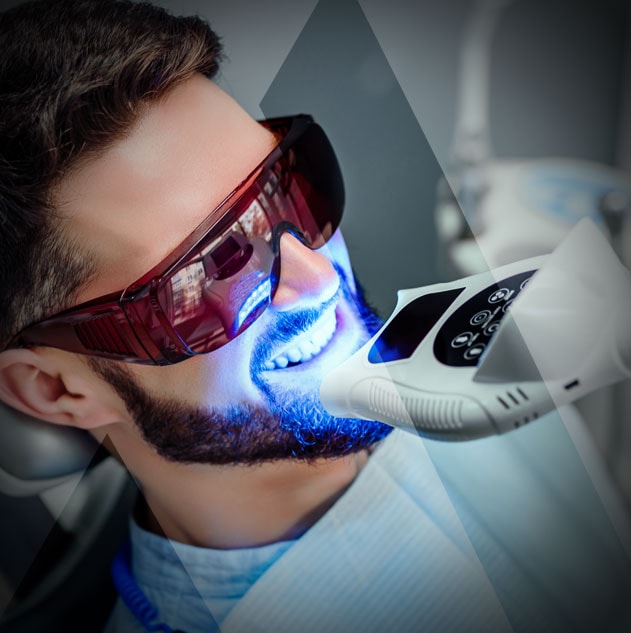
Laser whitening and Zoom (a branded light-activated system, also known as Philips Zoom) are the most popular and most searched options in Turkey, with searches such as “laser teeth whitening Turkey”, “Zoom teeth whitening Turkey” and “Philips Zoom teeth whitening Turkey cost”. They are marketed as faster and more effective, and they do give quick results in a single session of about an hour. In the laser method, the dentist cleans the teeth, protects the gums with a gel or a barrier, applies the bleaching gel (hydrogen peroxide) and directs a special light or laser at the teeth to speed up the reaction. In the Zoom method, the gel is activated by a lamp shining on the teeth for about 15 minutes, repeated three times, and the lamp treats all the teeth at once, whereas a laser may be directed at each tooth in turn.
The evidence on the extra benefit of the light or laser is limited: several studies and reviews find that the gel does most of the work, and that adding light does not always give a clearly better result, while heat from lamps can increase sensitivity. The practical difference is mainly speed and the fact that the treatment is done by the dentist under controlled conditions. The result depends on the gel concentration, the contact time, the starting colour and the type of stain. Dental lasers also require care, accuracy and skill, which is why the choice of dentist matters.
When comparing offers, ask what gel and concentration are used, what protects your gums and eyes, how many cycles are applied and what is done about sensitivity. Be wary of clinics that promise a specific number of shades regardless of your teeth.
Whatever the system, the result is immediate, but the shade can look a little lighter at the end of the session and settle slightly over the next day or two as the teeth rehydrate.
What is laser teeth whitening?
The laser teeth whitening process has spread due to its speed and effectiveness, as it takes place inside the dental clinic during one session and takes about an hour in most cases, unless the pigmentation is very complex that may need more than one session. Bear in mind that there are types of teeth that do not respond to laser whitening and other types that give excellent and immediate results, so it is necessary to consult a dentist before deciding to whiten your teeth. For example, yellow teeth respond to the laser and give good results, while brown or gray teeth, as well as the teeth that have been filled or installed, do not respond well to the laser whitening process, so it is necessary to resort to cosmetic and treatment methods other than bleaching.
What happens during the teeth cleaning process?
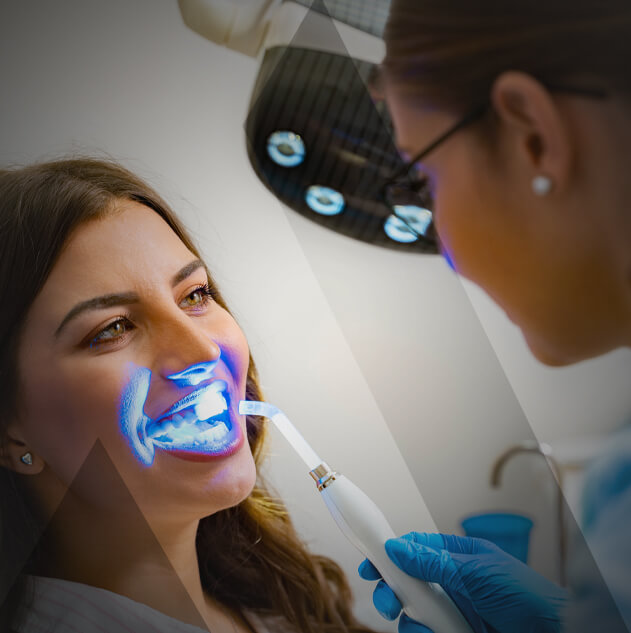
During the session, the doctor cleans the teeth from any deposits, then puts a gel on the gums to cover and protect them, and puts a bleaching gel containing hydrogen peroxide on the teeth. After that, the dentist directs a special light or laser at the teeth, which is intended to speed up the work of the bleaching gel; the added benefit of the light itself is limited. There is currently a technique for teeth whitening using the Zoom device, in which the bleaching material is stimulated by the Zoom device by shining the device on the teeth on which the gel was placed for 15 minutes and repeated for 3 times. The Zoom lamp illuminates all the teeth at once, whereas a laser may be directed at each tooth in turn.
Who is a good candidate for teeth whitening and who should avoid it?
The best candidates are adults with healthy teeth and gums and natural teeth whose yellowing comes from ageing, food, drink or smoking. Yellow teeth respond to whitening and give good results; brown or grey teeth, teeth with tetracycline or fluorosis stains, and teeth with fillings, crowns or veneers do not respond as well, because restorations do not change colour: if you have visible fillings or crowns, they may look darker after the natural teeth are whitened, and may need replacing to match. Because there are types of teeth that do not respond to whitening and others that give excellent and immediate results, it is necessary to consult a dentist before deciding to whiten your teeth. For some patients, other cosmetic and restorative methods, such as veneers or bonding, work better than bleaching.
Whitening is usually postponed or avoided in people with untreated decay, gum disease, cracked teeth or exposed roots, very sensitive teeth or worn enamel, active mouth ulcers, allergy to peroxide, and in children and teenagers whose teeth are still developing. It is generally avoided during pregnancy and breastfeeding because of the lack of safety data. People with a high expectation of an “Hollywood white” should know that natural teeth have a limit to how light they can go.
A responsible dentist will examine your mouth, ask about sensitivity and previous reactions, and advise you honestly whether whitening will give the result you want.
Searches for “candidates for teeth whitening in Turkey” reflect that question: the answer is a dental examination, not an online form.
Teeth whitening or dental veneers in Turkey: which should I choose?
| Factor | Teeth whitening | Veneers |
|---|---|---|
| What it does | Lightens the colour of natural teeth. | Covers the front of teeth with thin ceramic or composite shells. |
| Changes shape or alignment? | No. | Yes, within limits. |
| Invasiveness | Non-invasive. | Usually needs some enamel removal. |
| Reversible? | Yes, colour can fade. | The enamel removal is irreversible. |
| Durability | Months to a couple of years. | Years, but may need replacement. |
| Cost | Lower. | Much higher. |
| Suitable for severe stains | Limited. | Often yes. |
Whitening is the first step for most people who dislike the colour of their teeth: it is cheap, non-invasive and reversible. Veneers are chosen when the problem is also the shape, the spaces, small chips or deep stains that whitening cannot fix. Searches for “teeth whitening vs veneers in Turkey” show how common the choice is. Do not accept veneers when whitening would give you the result you want, because veneers involve removing enamel. See the guides to dental veneers and the Hollywood smile in Turkey.
If you plan veneers or crowns, whiten first and wait about two weeks before choosing the final shade.
What happens during a teeth whitening session, step by step?
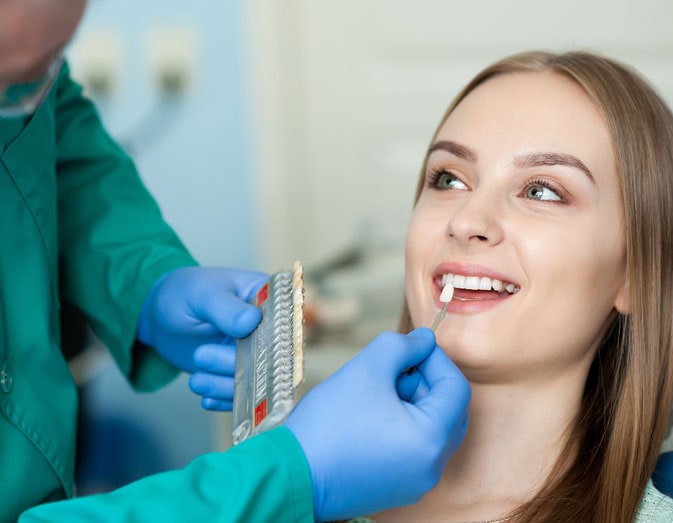
A session starts with an examination: the dentist checks your teeth and gums, takes the starting shade with a shade guide and photographs, and decides whether whitening is suitable. During the session, the dentist first cleans the teeth to remove any deposits and plaque. A protective gel or a rubber barrier is placed on the gums and lips to cover and protect them, and protective glasses are put on you. The bleaching gel, containing hydrogen peroxide, is then applied to the surface of the teeth. In the laser or light-activated methods, a special light or laser is directed at the teeth to speed up the work of the bleaching substance and increase its effectiveness; in the Zoom method, the lamp shines on the gel for about fifteen minutes and the cycle is repeated three times. The gel is then removed, the teeth are rinsed, and a desensitising gel or fluoride may be applied.
The treatment takes about an hour in most cases, unless the pigmentation is very complex, in which case more than one session may be needed. You can usually eat and drink within limits straight away, but you must avoid staining foods and drinks. The dentist records the new shade and may give you a take-home kit to maintain the result.
You might feel cold, a slight tingling or sharp sensitivity during the session; tell the dentist at once, because the cycle can be stopped or shortened.
Ask whether the dentist will do an examination and cleaning first, and what is done to protect your gums and eyes.
What are the benefits of teeth whitening?
Teeth whitening is a simple procedure that, in healthy teeth and in a dentist’s hands, lightens the colour of your teeth while keeping your natural look; it can cause temporary sensitivity. It works well on yellowing and surface stains, but deep stains (such as tetracycline or fluorosis stains) respond only partly. The results appear immediately after the session; a take-home kit may be advised to maintain the shade. Whitening takes less time and effort than most other cosmetic dental procedures, and less than take-home methods that need weeks.
What are the disadvantages of teeth whitening?
Despite the high efficiency of the dental whitening, there are still shortcomings in its uses.
Despite the effectiveness of dental lasers in the whitening process, there are types of pigmentation in the teeth that are strong and stubborn that do not respond to the whitening process.
Dental lasers also require great care, accuracy and skill and that can be troublesome to some people.
The result does not last for life, over time, the pigmentation returns and you may need to re-whiten again, and you can keep your teeth for a longer period the more you take care of their cleanliness and eat healthy food.
What are the risks of teeth whitening?
Like any dental treatment, it has benefits and side effects that often result from the use of a high-concentration bleaching gel, and they differ from person to person.
Some of the risks are :
- Tooth sensitivity, which is common and usually temporary, and irritation or inflammation of the gums.
- Soreness or ulcers on the lips, tongue and inside of the cheeks if the gel touches them.
- Chemical burns of the gums or irritation of the tooth pulp with very strong gels or heat (rare).
- Uneven results, and fillings, crowns and veneers that do not change colour and may look darker by comparison.
- Eye irritation if the eyes are not protected during a light or laser treatment, which is why protective glasses are used.
What are the risks and side effects of teeth whitening?
Teeth whitening is generally safe when carried out by a dentist on healthy teeth, but, like any dental treatment, it has side effects and risks, which come mainly from the use of a high-concentration bleaching agent and differ from person to person. The most common is temporary tooth sensitivity, felt as short, sharp pains with cold or hot, which usually settles within one to three days. Gum irritation or whitening of the gum margin (a temporary chemical irritation) can occur if the gel touches the gums. Less often, there can be sore patches or ulcers on the lips, tongue or inside of the cheeks if the gel contacts them. Results can be uneven, with patchy or banded whitening, and restorations will not match.
More serious problems are rare and usually result from misuse: a chemical burn of the gums or mouth with very strong or poorly isolated gels, damage to the enamel with abrasive or acidic products, worsening of existing decay or cracks, and eye irritation if the eyes are not protected, which is why protective glasses are used during light or laser treatments. Whitening does not destroy nerves or weaken the bone, as some descriptions state, but a very strong gel or heat from a lamp can irritate the pulp of the tooth, causing prolonged pain that needs dental attention.
Sharp sensitivity that does not settle after three days : contact your dentist.
Persistent pain in one tooth : possible pulp irritation or an unseen problem: seek dental care.
White, painful or blistered gums : chemical irritation: rinse and contact the dentist.
Sore ulcers that last beyond a week : see a dentist.
Eye pain, redness or blurred vision after a light-based treatment : seek medical care at once.
You can reduce risks by choosing a dentist who examines you first, uses a gum barrier, controls the gel strength and time, uses protective glasses and offers desensitising care. Avoid whitening more often than advised.
Tell the dentist about any previous sensitivity or reaction and about your medicines.
What should I eat and drink after whitening and how long do the results last?
For the first forty-eight hours after whitening, the teeth are more porous and take up stains more easily, so follow a “white diet”: avoid coffee, tea, red wine, cola, dark sauces such as soy and balsamic, curry, beetroot, berries, tomato sauce and tobacco, and choose chicken, fish, rice, pasta, potatoes, white bread, cauliflower, bananas, yoghurt and water. Use a straw for drinks that stain, brush gently with a soft brush, and rinse after eating. If you are sensitive, use a desensitising toothpaste and avoid very hot or very cold food and drink.
The result does not last for life. Over time, pigmentation returns, because new stains build up and because teeth continue to age. The effect typically lasts from several months to a couple of years, depending on how much you consume staining food and drink, whether you smoke or vape and how well you clean your teeth; you can keep your teeth lighter for longer the more you take care of their cleanliness and eat healthily. A touch-up with a take-home kit every six to twelve months can maintain the shade. Regular dental hygiene visits help to keep surface stains under control.
Smoking and vaping are the quickest way to undo whitening. If you want a lasting result, consider stopping.
Do not use whitening products too often, as overuse can irritate gums and wear the enamel.
How should I read teeth whitening before and after photos and reviews from Turkey?
Photographs of whitened teeth are easy to manipulate: lighting, camera settings, a dry versus wet tooth surface, retraction of the lips and filters all change the apparent shade. A fair before-and-after photograph is taken in the same light, at the same distance, with a shade guide beside the teeth, and ideally includes a photograph some weeks later, once the teeth have rehydrated. Some images show veneers rather than whitening, because veneers can be much whiter than natural teeth can ever become. Reviews can be solicited or paid for, and negative reviews can come from competitors.
Ask the clinic for before-and-after photographs of whitening alone, with the shade guide, and for the number of shades gained as measured on a shade guide. Searches such as “teeth whitening Turkey before and after” and “teeth whitening in Turkey reviews” are frequent; treat marketing images as advertising and trust the dentist’s examination more than the picture.
A realistic expectation is a few shades lighter, not a different colour. Natural teeth have a limit, and extra-white “Hollywood” teeth generally mean veneers or crowns.
A second opinion from a dentist at home on whether whitening will suit you is a sensible precaution.
Whitening can lighten your teeth by several shades in an hour, but it is a temporary treatment that suits healthy natural teeth and needs a dental examination first. Choose the dentist and the product before the price, expect results to fade over months to years, and plan any veneers or crowns after whitening.
Should I whiten before veneers, crowns or implants, and what about braces and sensitive teeth?
If you are planning veneers, crowns or other cosmetic dental work, whiten first: the dentist can then choose the shade of the new teeth to match the lighter natural teeth, and, because whitening settles over about two weeks, many dentists wait before taking the final shade. Whitening cannot change the colour of existing crowns, veneers or fillings afterwards, so the order matters. If you have implants or bridges, the front teeth next to them can be whitened, but the prosthetic teeth will stay the same colour and may need to be redone to match. If you wear braces or aligners, whitening is usually done after treatment, although some dentists use the aligner trays as whitening trays under supervision.
If your teeth are sensitive, discuss it beforehand: a dentist may recommend using a desensitising toothpaste for a couple of weeks before whitening, choosing a lower-strength gel, shortening the session or using a take-home regimen of lower strength over a longer time. Some people with sensitive teeth do better with gradual whitening than with a single strong session.
People with large fillings or old crowns in the smile zone should ask the dentist whether the restorations will stand out after whitening.
All of this is easier to plan with a single dental team, which is one reason whitening is often part of a larger dental package in Turkey.
How long should I stay in Turkey for teeth whitening and what if I am combining it with other treatment?
For whitening alone, one day is enough: the examination, cleaning and session take a few hours, and you can fly the same or the next day. Many clinics ask patients to stay a second day for a quick check and, if relevant, to collect a take-home kit. If whitening is part of a larger dental treatment, the stay is determined by the main treatment: a few days for veneers, five to ten days for implants, with a second visit later. Flights to Istanbul are about three and a half to four hours from the UK and Western Europe and around nine to eleven hours from the US East Coast. Check the current visa or e-visa requirements for Turkey on the official government sites before you book, and make sure your passport is valid for the whole stay.
Avoid staining foods and tobacco on the journey home, bring a desensitising toothpaste and keep water at hand. You do not need a companion for whitening alone.
Hotel nights near the clinic make appointments easier. If the clinic offers an all-inclusive package, check the list of what it covers.
Keep a copy of your treatment record, the product used and any take-home kit instructions, in case you need to see a dentist at home.
How do I choose a dentist and clinic for teeth whitening in Turkey and is it safe?
| What to check | Why it matters | How to verify |
|---|---|---|
| Dentist’s qualification | Whitening should be done by a dentist, not a beauty technician. | Name, dental degree, registration; clinic is a dental clinic. |
| Examination and cleaning first | Decay and gum disease must be treated before whitening. | Check-up and X-ray if needed; written plan. |
| Product and concentration | Strength determines risk of sensitivity and burns. | Brand, type of gel and concentration told to you before the session. |
| Protection of gums and eyes | Chemical burns and eye irritation are avoidable. | Gum barrier and protective glasses used. |
| Realistic promise | Results differ by tooth and stain. | No guarantee of a number of shades; shade guide used. |
| Clinic licence and hygiene | A licensed clinic follows hygiene rules. | Licence from the Turkish Ministry of Health; clinic address. |
| Aftercare | Sensitivity needs advice. | Written instructions and contact. |
Is teeth whitening in Turkey safe? It can be, when done by a qualified dentist with a controlled product, a gum barrier and sensible timing, on healthy teeth. It is riskier when the gel is very strong, the dentist does not examine you, or the treatment is offered by a non-dental clinic. Be sceptical of rankings such as “best teeth whitening in Turkey”: there is no reliable public ranking. A second opinion from a dentist at home on whether whitening suits you is a sensible precaution.
Aram Clinic says it works with experienced dentists: ask for the clinic and the dentist by name in writing, ask what product and concentration will be used and verify the answers yourself.
What if I have a problem after whitening abroad, and does insurance cover it?
Most whitening side effects, such as sensitivity and mild gum irritation, settle in a few days with desensitising toothpaste, avoiding very hot and cold food and rinsing with water. If pain is severe or lasts beyond three days, if a gum is white and blistered, or if an ulcer persists, see a dentist: any dentist at home can examine the mouth and treat irritation. For emergency problems such as eye pain after a light treatment, go to an eye emergency service. Cosmetic whitening is not covered by public health systems or by most dental insurance plans, and travel insurance usually excludes planned cosmetic treatment and its complications.
Before you travel, ask the clinic in writing what happens if you have a problem: who you contact, whether the dentist will advise your local dentist and whether a re-treatment is included.
Keep your records: the quote, the product and concentration used, the date and the instructions.
Should I use a dental tourism agency or contact the clinic directly?
Some patients use agencies that organise the trip and introduce them to a clinic, often through social media or messaging apps. This can simplify logistics, but it creates a conflict of interest when the agency is paid a commission by the clinic: its incentive is to sell a package, often including more dental treatment than you need. An agency is not a dentist and cannot replace an examination. Warning signs include whitening offered with no examination, guaranteed results, packages that add veneers or crowns you did not ask for, pressure to book quickly and offers sent by chat message.
Whatever route you use, make sure you know exactly who is responsible for the dental care (the clinic and the dentist), who invoices and who is reachable if you need help. Ask for the contract in writing, naming the clinic and the dentist, and do not pay a large deposit to someone you have not identified. Ask Aram Clinic what its exact role is, who the contracting parties are and how complaints are handled.
How does the process work with Aram Clinic, from the first enquiry to going home?
Aram Clinic describes a simple journey. First, you request a free quote online, with photographs of your teeth and any dental X-rays. Second, the dental team reviews them and a dentist or coordinator discusses your case with you, usually by video, explaining the proposed method, the risks and the alternatives. Third, you receive a written proposal and decide without pressure. Fourth, you travel: you are met on arrival and taken to the hotel or clinic according to the plan. Fifth, after the examination and cleaning, the whitening takes place at the partner clinic, followed by a short check. Sixth, you return home with your records and care instructions, and the team stays in touch remotely.
These are the clinic’s own descriptions. For your safety, check that the dentist and the clinic are named in writing, that the product and its concentration are specified, that the quote lists what is and is not included, and that the team will advise against whitening if your teeth are not suitable.
The first step is simple: complete the free express quote with your photographs, or learn more about Aram Clinic.
What questions should I ask before booking teeth whitening in Turkey?
Are my teeth suitable : has a dentist examined my teeth and gums and told me what stain I have?
Which method and which product : what gel and concentration, with or without light?
How will my gums, lips and eyes be protected : and what is done about sensitivity?
How many shades can I realistically expect : measured on a shade guide?
How long will it last and how do I maintain it : is a take-home kit included?
Will it match my fillings, crowns or veneers : and what if it does not?
What is included in the quote : extra nights, take-home kit, re-treatment?
What happens if I have a problem after I go home : who do I contact?
Write your questions down and ask for the answers in writing. Take your time: whitening is a simple treatment, but a rushed session with a very strong gel can cause pain that lasts for days, and no discount is worth deciding under pressure. A second opinion from a dentist in your own country is a sensible precaution.
A team that examines your teeth, tells you the product and concentration, discusses limits and advises against whitening when it is not appropriate is more trustworthy than one that promises the whitest teeth at the lowest price.
Teeth whitening in Turkey: a dental examination first, the gel and its strength second, the price last
Teeth whitening in Turkey lightens natural teeth by several shades in an hour-long session with a peroxide gel, with or without a light or laser, and the result lasts from several months to two years depending on diet, smoking and care. It works best on yellowing and surface stains in healthy teeth and gums; it does not change fillings, crowns or veneers, and it is limited on grey or brown stains. Quotes are generally lower than in the UK or the US, and all-inclusive packages bundle the hotel and transfers, but for whitening alone the cost of travel often cancels the saving, so it makes most sense as part of a larger dental plan such as veneers or implants, where whitening is done first. The usual side effects are temporary sensitivity and gum irritation; the risks rise with very strong gels, rushed sessions and no examination, and the extra benefit of laser or Zoom light over the gel alone is limited. Cosmetic whitening abroad is not covered by insurance.
Before booking, ask whether a dentist will examine your teeth and gums first, which product and concentration will be used, how your gums and eyes will be protected, what shade change is realistic, and what happens if you have a problem after your return. If your project is ready, the next step is to send photographs of your teeth to the Aram Clinic team through the free express quote, so that they can review your case and propose a written plan that you can discuss with your own dentist, without pressure.
Official sources to consult
This page draws on the sources below. Guidelines and rules change: always consult the current version and your own dentist’s advice.
NHS : nhs.uk : patient information on teeth whitening, risks and who should do it.
General Dental Council : gdc-uk.org : rules on who may carry out tooth whitening in the UK.
British Dental Association : bda.org : patient advice on tooth whitening and dental tourism.
American Dental Association : ada.org : patient guidance on tooth whitening (MouthHealthy).
European Commission : europa.eu : EU rules on hydrogen peroxide in tooth-whitening products.
Joint Commission International : jointcommissioninternational.org : international accreditation (verify any claim on the accreditor’s site).
Republic of Türkiye Ministry of Health : saglik.gov.tr : licensing of health facilities and health tourism.
UK Government and US State Department travel advice : gov.uk and travel.state.gov : entry requirements and health travel advice.